VPP Week-In-Review — Weeks of June 15 & 22, 2026
Your weekly brief on virtual power plants in the US & Canada.

Three Takeaways
Tesla’s New England lease model shows VPP revenue can make storage hardware cheaper up front instead of just paying back over time — a pitch every storage competitor will now have to answer.
Sunrun, Tesla, and Renew Home just showed residential VPPs can put gigawatt-scale capacity behind data center load without new hardware, new interconnection, or new generation.
FERC and Texas regulators are both steering large loads toward curtailment-based interconnection instead of new generation — a tacit endorsement of demand flexibility as grid infrastructure.
News Roundup
Regulatory & FERC · 🟢 Bullish
FERC Issues Show-Cause Orders to All Six RTOs/ISOs on Large-Load Interconnection 📅 Published: 06/18/2026
FERC issued Section 206 show-cause orders to PJM, MISO, SPP, CAISO, ISO-NE, NYISO, and their transmission owners, giving them 60 days to justify or revise large-load interconnection tariffs and 30 days to file resource-adequacy reports. Co-location and behind-the-meter generation are explicitly named among the five reform categories. That puts DER aggregators with data-center-adjacent flexibility plays directly in the rulemaking conversation as DOE’s RM26-4 ANOPR advances in parallel.
Grid Reliability · 🟢 Bullish
IESO Summer 2026 Reliability Outlook: Peak Perks Tops 320,000 Participants, Commercial “Peak Performance” DR Program Debuts 📅 Published: 06/19/2026
IESO’s seasonal reliability outlook reports Save on Energy Peak Perks, Canada’s largest residential VPP, has passed 320,000 participants and now delivers 200+ MW of demand reduction. A new commercial “Peak Performance” demand-response program is also launching this summer, while the existing Industrial Conservation Initiative (ICI) — which lets large industrial and commercial customers cut their Global Adjustment charges by shedding load during the province’s five annual coincident peaks — is expected to deliver roughly 1,500 MW this season. The backdrop is a system peak that could approach 26,000 MW under extreme weather, with battery storage now at 17 projects and 1,050+ MW — triple last summer’s fleet.
Product Announcements · 🟢 Bullish
Tesla Launches Discounted Powerwall Leases Tied to Mandatory VPP Enrollment in New England 📅 Published: 06/18/2026
Tesla is piloting Powerwall leases in Massachusetts and Connecticut that cost $30–$60 less per month — close to half off a standard lease — in exchange for mandatory enrollment in Tesla-controlled VPP dispatch. The structure inverts the usual model: VPP revenue now subsidizes the lease price instead of arriving as a bonus after the sale. If the pilot holds up, it gives Tesla a sharper customer-acquisition edge over storage competitors still selling VPP enrollment as an add-on.
Partnerships · 🟢 Bullish
Tesla, Sunrun, and Renew Home unveil 16.8 GW VPP framework for data centers 📅 Published: 06/24/2026
The three companies are aggregating home batteries from Sunrun and Tesla with more than 8 million smart thermostats and devices from Renew Home into what they’re calling the largest VPP in the country. 300 MW is available now in Virginia, with a path to 500 MW by 2030, using existing residential infrastructure — no new hardware, interconnection, water, or land required. This is the clearest signal yet that aggregators see hyperscaler load as a bigger near-term revenue opportunity than utility programs.
Utility Programs · 🟢 Bullish
FranklinWH + Ava Community Energy Launch $6,000 VPP Incentive for Income-Qualified Bay Area Homeowners 📅 Published: 06/16/2026
Ava Community Energy, a CCA serving 2M+ households in Alameda and San Joaquin counties, is offering CARE/FERA-qualified homeowners up to $6,000 upfront plus roughly $36/month to enroll a FranklinWH battery in its VPP — more than five times the roughly $1,080 available to market-rate customers. Homeowners can choose to share 40%, 60%, or 80% of battery capacity with the grid. It’s a notable design choice: most VPP incentive programs still skew toward customers who can already afford storage without a subsidy.
Partnerships · 🟢 Bullish
Rivian Joins ChargeScape for Managed EV Charging 📅 Published: 06/16/2026
Rivian has joined ChargeScape, the automaker-backed managed-charging platform that already includes Tesla, Ford, BMW, Honda, Nissan, and Stellantis. Utilities can now shift Rivian owners’ charging off-peak directly through the Rivian app, with no separate program enrollment required. The move adds another ~large EV fleet to ChargeScape’s addressable base as utilities lean on managed charging to absorb data-center-driven load growth.
Regulatory & FERC · 🟡 Neutral
Texas, facing 438 GW queue, approves initial large-load interconnection process 📅 Published: 06/22/2026
The PUCT approved ERCOT’s “Batch Zero” framework, which studies large-load interconnection requests in groups rather than sequentially. The tradeoff: customers who accept curtailment during transmission constraints get a faster path to connect. It’s not a VPP program, but it normalizes the same curtailment-for-access logic aggregators have been selling utilities for years — now applied directly to data centers.
Research & Reports · 🟢 Bullish
GETs, demand response can ease near-term data center electricity price pressure: report 📅 Published: 06/23/2026
New research finds grid-enhancing technologies and demand response can blunt the near-term price impact of data center load growth faster than new generation can come online. It’s a useful data point for any utility making the case for DR/VPP spend over a new peaker plant in front of a rate case.
Research & Reports · 🟡 Neutral
Wood Mackenzie releases Q2 2026 US Energy Storage Monitor 📅 Published: Wed, Jun 24, 2026
Wood Mackenzie and the American Clean Power Association released the Q2 2026 edition of their quarterly US Energy Storage Monitor, covering deployments, pricing, and policy across front-of-meter and behind-the-meter markets. Wood Mackenzie estimates that 28 GW cumulative residential energy storage will be installed by 2031.
Utility Programs · 🟢 Bullish
Platte River, EnergyHub partner to deploy 39-MW Colorado VPP 📅 Published: 06/24/2026
Platte River Power Authority is partnering with EnergyHub on a 39-MW residential VPP deployment in Colorado — incremental, but another Western utility moving from pilot to live program this year.
📊 By the Numbers
320,000+ — residential and small-business participants now enrolled in Ontario’s Peak Perks, Canada’s largest residential VPP.
1,500 MW — expected demand reduction from Ontario’s new commercial “Peak Performance” DR program launching this summer.
60 days — window FERC gave all six RTOs/ISOs to justify or revise large-load interconnection tariffs.
$6,000 — upfront incentive available to income-qualified Bay Area homeowners enrolling a FranklinWH battery with Ava Community Energy.
16.8 GW — combined dispatchable capacity Sunrun, Tesla, and Renew Home say they can offer utilities and data centers.
438 GW — size of ERCOT’s large-load interconnection queue, ~89% of it data centers.
39 MW — size of Platte River’s new residential VPP deployment with EnergyHub in Colorado.
🗓️ On the Radar
July 18, 2026 — Deadline for RTOs/ISOs to file 30-day resource-adequacy reports under FERC’s large-load show-cause order.
August 17, 2026 — Deadline for RTOs/ISOs and transmission owners to file compliance responses to FERC’s Section 206 large-load tariff order.
August 2026 — ERCOT expected to notify “Batch Zero” applicants of their large-load project classification.
💬 My Take
Over the last two weeks, announcements by Tesla, Sunrun, Renew Home and FranklinWH all point to different ways to potentially integrate residential batteries into VPPs. They point to the scale of capacity that could quickly be brought online and how VPPs could enable decreased costs for residential customers to access batteries. I see us going from a world where about one third to 45% of residential batteries are participating in VPPs today to a future where VPPs are the default option for low cost lease payments and over 60% of new customers purchasing with a lease are participating.
The size of residential storage and VPPs
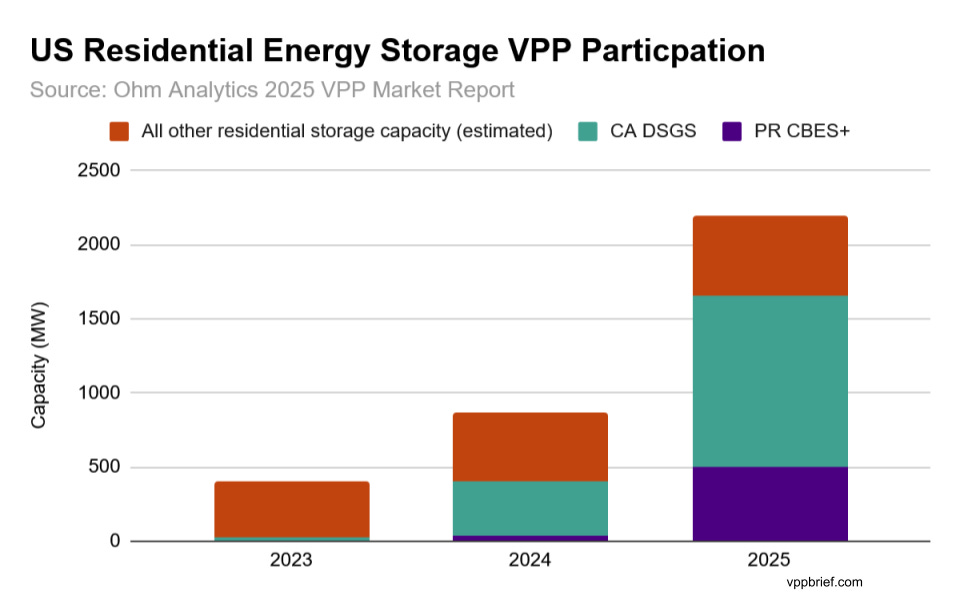
According to Ohm Analytics, residential batteries have grown from 870 MW of cumulative residential battery nameplate capacity enrolled in VPPs in 2024 to 2,200 MW of cumulative nameplate capacity in 2025. This growth was driven by Puerto Rico’s CBES program and California’s Demand Side Grid Support (DSGS). Ohm Analytics also estimates that 45% of deployed batteries are integrated into VPPs. That implies total deployed battery capacity according to Ohm Analytics is 4,888 MW by the end of 2025.
I wanted to compare that with other sources like the recently announced Wood Mackenzie Energy Storage Monitor because they have been tracking the residential storage market longer than Ohm Analytics. Wood Mackenzie’s public data shows there was 5.8 GW of residential storage installed between 2021 and 2025 alone (2021, 2022-2023,2024-2025). Looking at residential storage installed data prior to 2021, I estimate approximately an additional .5 GW of residential capacity was installed assuming an average 2-hour duration system. If there are approximately 6.3 GW of installed residential storage as of 2025, approximately one third was participating in VPPs.
With Tesla and other companies’ recent announcements to integrate VPP revenues into decreased lease payments, I see the potential for doubling this historic VPP-participation rate.
When VPPs made residential storage about the price of two phone lines
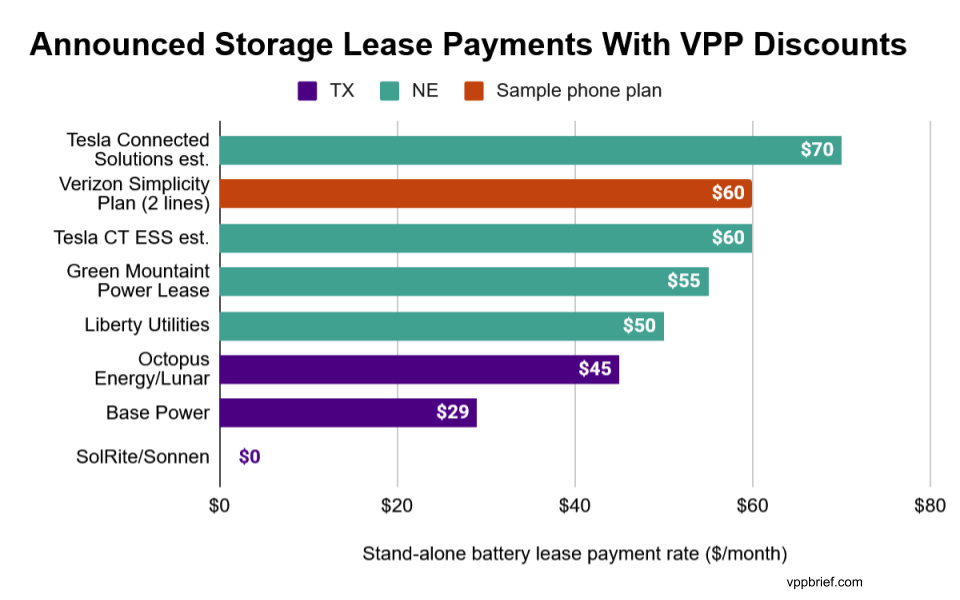
On June 18th, Tesla announced that they would bundle VPP participation in Connecticut’s ESS program and ConnectedSolutions (CS) that would result in up to 29% savings in CS and 49% in CT ESS monthly savings. They estimate the savings at $30 per month in ConnectedSolutions and $60 per month savings in CT ESS. If I assume that the high end monthly savings percent aligns with the month savings amount, I estimate that you could get a powerwall for around $70 per month ($30/.29-$30) when you sign up for their VPP in ConnectedSolutions and around $60 per month ($60/.49-$60) in CT ESS. Tesla’s announcement isn’t the first to do this.
The idea was pioneered by Swell. While they were not able to make the economics and scale work at the time, the concept of decreasing the cost of a battery by enabling VPP participation was initially iterated on in utility programs like Green Mountain Power in Vermont starting in 2017. The utility now offers a lease of $55 per month. Liberty Utility offers a $50 per two battery lease in New Hampshire.
In Texas, a number of retailers have partnered or integrated batteries at no or low cost. In January 2025, Sonnen and Solrite developed a $0 offering for residential storage in Texas. Base Power’s REP offering in Texas is premised on a similar framework where a customer pays $19-29 per month for a battery and a lower cost for electricity. Octopus Energy and Lunar Energy’s PowerStore Partnership announced in April 2026 is also premised on a $45/month lease payment and 8 cents/kwh. These are not all apples-to-apples comparisons with nuances on the reserve capacity available to the homeowner and associated retail rates. However, they point to a future where batteries in large parts of the country are under $75 per month and by default would be enrolled in a VPP.
Why this matters for the future of residential storage VPPs
Storage leases are becoming more important because third party owners can still access the investment tax credit for batteries. In Sunrun’s Q1 2026 investor presentation they highlight that prior to the loss of the ITC, Third-Party-Owned (TPO) solar systems were 50% of the market according to Wood Mackenzie. I am assuming this is a reasonable proxy for the share of storage systems that are leased prior to the ITC expiring for loan and cash payments. If lease providers can find ways to cut the cost of a lease payment with VPP revenue streams, it decreases the cost of energy storage while simultaneously increasing VPP participation rates above the one third of battery storage participating in the US today.
Tesla, Sunrun and Renew Home’s new capacity discovery tool is an indication of what could be possible. While the full portfolio is 16.8 GW, the storage nameplate capacity from Sunrun and Tesla in the VPP capacity explorer tool is 7.8 GW. This is 1.5 GWs above Wood Mackenzie’s market size from just two companies. Tesla and Sunrun are clear that not all of that capacity is deployed today, but could be deployed in “months, not years.” If these companies can work with partners to get long term contracts for capacity, those predictable revenues could unlock residential storage lease discounts and increase adoption for VPPs and energy storage.
The scale of growth potential is also supported by a recent Brattle report on Operationalizing and Quantifying the Demand Stack. Brattle noted with data from Uplight that just moving enrollment to the point of sale would increase conversion rates from 5-10% to 40%-75% without changing anything around incentives. If you layer in improved incentives, they estimate being able to get incremental participation. I think a 60% participation rate for new customers is feasible because the incentives associated with enrolling can be north of 50% of the lease payment. And if this can be paired with Bring-your-own-capacity style contract, additional regions beyond New England and Texas could be unlocked with longer term market pricing.
Wood Mackenzie forecast in the recent Energy Storage Monitor that there will be 21 GW of incremental residential storage capacity above 2025 capacity (14% of ~150 GW of incremental capacity). If these offerings were available nationwide and lease financing held at ~50% of systems, a 60% participation rate for new systems would add ~6 GW of incremental residential storage VPP capacity by 2031, nearly 3X the cumulative residential storage VPP capacity in 2025.
What Did I Miss — or Get Wrong?
Spot a story that should have been in this week’s issue? Disagree with the way I’m interpreting the facts? Just comment in notes with a link to the story or your take.
Opinions are my own and not the views of my employer. Research and drafting for this issue was produced with the assistance of Claude AI. All editorial decisions are mine.