The 7 most informative VPP podcasts in H1 2026
What are the seven most informative VPP podcasts in North America from January to June of 2026?

I listened to over 20 podcasts on VPPs. They’re ordered by the sequence I’d recommend — starting with high-level policy and market fundamentals before zooming into utility, vendor, and analyst views. Here are the podcasts, a brief overview and why I think each matters.
The three interrelated questions I see across these podcasts are:
What will be the tailwinds for VPP growth over the next three years?
What are the headwinds to VPP growth today?
How are utilities, aggregators and data center developers and operators working together to enable this market?
If you want this as a playlist, here’s the Spotify playlist. I included links to each episode on both Apple Podcasts or YouTube and Spotify.
Ryan Hledik — USEA Power Sector Podcast (April 2026)
Podcast Overview: If you only have time for one episode to get your bearings on VPPs in 2026, make it this one. Hledik has been tracking the economics of load flexibility longer than most, and his conversation with journalist Herman Trabish covers the full arc: where VPPs started, what’s actually moved the needle on adoption, and why the affordability crisis has changed the calculus for utilities, regulators, and investors.
🎧 Listen here 🎙️ Apple Podcasts
Why? Hledik frames how VPPs fit into the current electricity affordability crisis across the country. He highlights the speed and cost advantages of VPPs. That value proposition is critical for understanding current market drivers. He also highlights headwinds like lack of trust for VPPs as a resource. I agree with his insights on the potential for VPPs to provide meaningful savings compared to traditional alternatives.
Caroline Golin — Open Circuit (January 2026) Latitude Media
Podcast Overview: Affordability is the defining energy issue of 2026, and this episode maps the two competing strategies for tackling it: the Trump administration’s blunt-force federal play to reshape PJM capacity markets, and the quieter state-level push in Illinois, Virginia, and New Jersey to use VPPs to flatten peak demand without building more gas. Golin — formerly Google’s global head of energy market development — brings a sharp lens to how bring-your-own-device programs fit into PJM’s supplemental auction and what it actually takes to turn grid constraints into policy leverage.
🎧 Listen here 🎙️ Apple Podcasts
Why? This conversation is for understanding how Bring-Your-Own-Distributed-Capacity fits into addressing grid constraints related to data center buildout and PJM’s supplemental auction. This is the best framework I’ve heard for understanding how hyperscalers think about the opportunities and barriers of working with VPPs to bring data centers online faster. I learned about the gaps aggregators need to address to make VPPs an easy yes for hyperscalers: risk allocation, incremental customer acquisition and contract simplicity.
Mark Dyson — Build, Repeat. / A Paces Podcast (March 2026)
Podcast Overview: The best historical context for the current moment I’ve come across. Dyson, Managing Director of Electricity at RMI, reaches back to the 1960–2000 grid build-out — when US utilities grew demand 4–5x while cutting real electricity prices by 20% — to argue that today’s data center surge is a solvable problem, not a crisis. The policy and market design lessons from that era translate directly to the VPP case. His core claim is blunt: VPPs are cheaper than gas peakers or batteries for meeting new peak demand and faster to deploy. He also tackles the hyperscaler flexibility paradox — why data center operators resist curtailment at the project level and how paying others to flex resolves that tension.
🎧 Listen here 🎙️ Apple Podcasts
Why? VPPs often get touted as a new technology. Demand response started with the 1973 oil embargo. Understanding the historical context is critical to understanding this moment in the electricity market and lessons we can take from prior demand booms.
Kerri Carnes — The Grid Mod Pod / AEIC (March 2026)
Podcast Overview: Carnes, Director of Customer Solutions at Arizona Public Service, tells the story of how APS built trust — with customers, with operations teams, and with regulators — for a 165 MW VPP combining smart thermostats, behavioral demand response, C&I DR, and batteries. This isn’t a pitch; it’s a post-mortem on what actually worked and what didn’t. With APS projecting significant peak demand growth over the next five years, hearing how a utility leader thinks about program design, customer economics, and operational credibility is essential.
🎧 Listen here 🎙️ YouTube
Why? Hearing how a utility leader is thinking about the value and needs for these programs in their territory is critical for understanding the future of VPPs. LBNL estimates that 60% of VPP programs are led by utilities.
Seth Frader-Thompson — Volts (January 2026)
Podcast Overview: Frader-Thompson, CEO of EnergyHub, lays out a maturity framework for VPPs — walking through exactly what it takes for a distributed fleet to move from “enhanced demand response” to something a utility control room operator genuinely cannot distinguish from a conventional peaker. The episode covers dispatch predictability, event performance, telemetry requirements, and the operational trust-building that has to happen before utilities will lean on VPPs the same way they lean on gas turbines.
🎧 Listen here 🎙️ Apple Podcasts
Why? EnergyHub put forward a framework on when VPPs would be able to directly replace a peaker plant in a control room and a utility operator wouldn’t be able to tell the operational difference. This is a great primer on thinking about where VPP operations are going within utility-led VPPs. I valued this for thinking about when VPPs will reach parity with traditional power plants, and their potential to eventually provide value beyond traditional power plants.
Varun Sivaram — Catalyst with Shayle Kann (April 2026)
Podcast Overview: The conversation that cuts through the data center flexibility hype. Sivaram, CEO of Emerald AI, returns to Catalyst to explain the mechanics of what actually makes a data center grid-interactive — breaking down temporal, spatial, and resource-based flexibility, the emerging “Watt-Bit spread” that makes power flexibility economically rational for hyperscalers, and why Emerald’s partnership with NVIDIA is the first real test of a 96 MW truly power-flexible AI factory. The episode also surfaces the harder coordination problem: aligning utilities, cloud providers, and grid operators around a common dispatch architecture.
🎧 Listen here 🎙️ Apple Podcasts
Why? Thinking through the economics and capabilities for data center flexibility is complex and there is a lot of hype. This conversation outlines the value to data center operators and the entities that need to be coordinated to make data center flexibility a reality. Google already has 1 GW of flexibility and there are pathways where data centers’ flexibility may come to the grid outside of utility or market constructs (May 18th Brief). I see data center flexibility as a large risk and opportunity: it could be a boon for VPPs or uncompensated capacity that decreases the value of VPPs. If data center developers and operators are pushed into interruptible tariffs and emergency load-drop requirements, grid flexibility could be enabled without participating in markets and cannibalize the value for VPPs.
Bruce Nordman — Volts (May 2026)
Podcast overview: Veteran research scientist Bruce Nordman argues that dynamic, time- and location-specific retail prices — sent directly to consumer devices — are a better coordination mechanism than VPP aggregators for most use cases. No middleman, more value captured by customers, cleaner market signals. It’s the strongest version of the “prices over programs” argument you’ll hear, and worth sitting with even if you disagree. The practical limits of price responsiveness at current device penetration levels are real, but the long-run question Nordman is raising — how we coordinate billions of connected devices across a home — is one the industry will have to answer.
🎧 Listen here 🎙️ Apple Podcasts
Why? There are regular debates about the value of dynamic rates in addition to VPPs for creating grid flexibility. This is one of the most thoughtful articulations of the argument I’ve heard. I don’t agree about this, at least in the short term, because of the limits of flexible assets in most customers’ homes and businesses. And I think price’s ability to shape load scalably will be critical for billions of devices to coordinate within homes and businesses. This is important for the industry and markets to consider for a 5-10 year time horizon.
💬 My Take
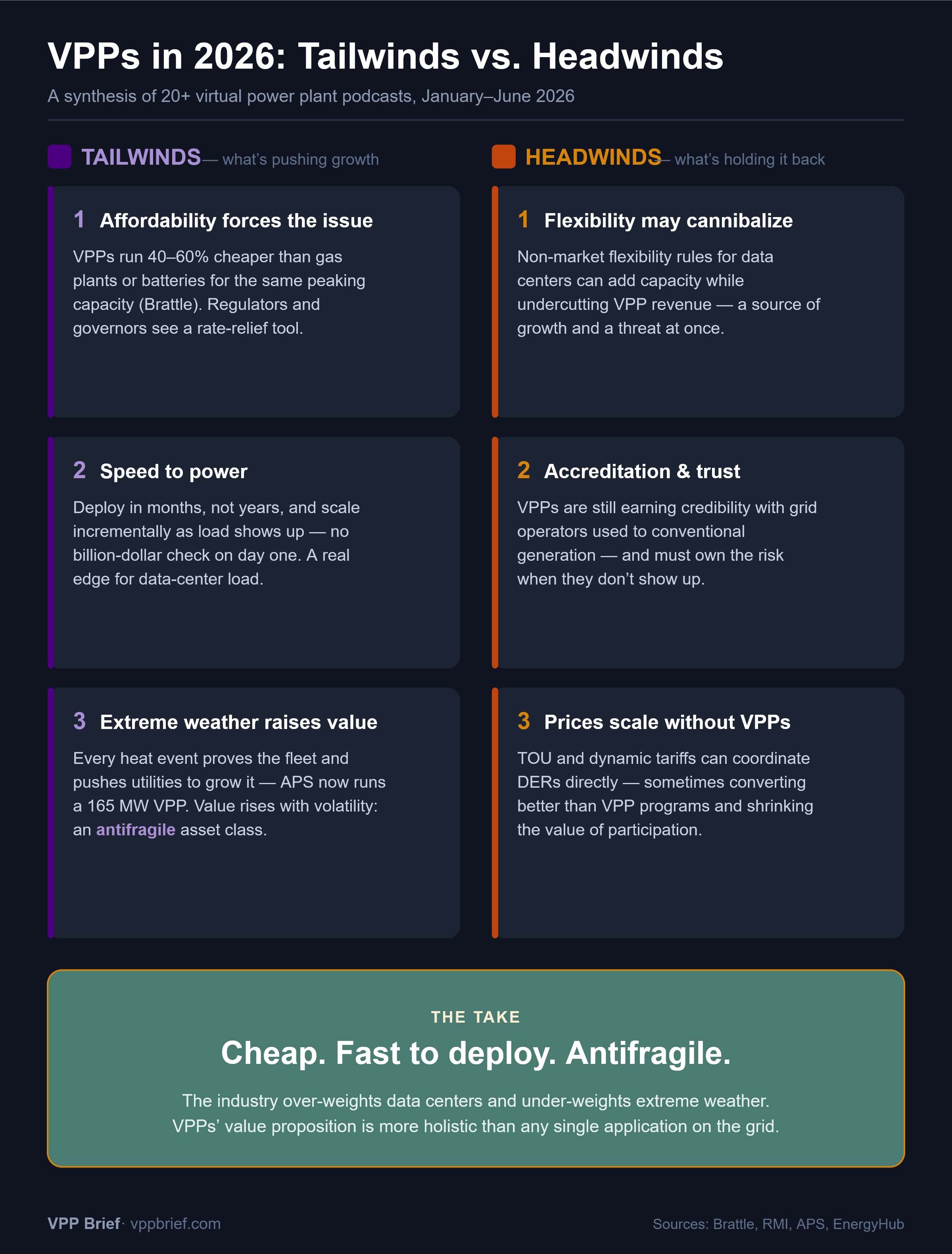
Listening to all of these podcasts I want to synthesize the top three tailwinds and headwinds for the industry:
What will be the tailwinds for VPP growth over the next three years?
Affordability is forcing the issue. Ryan Hledik’s Brattle Group study found VPPs run 40-60% cheaper than gas plants or batteries for the same peaking capacity. This has regulators and governors looking for this as a tool to help mitigate rate increases.
Speed to power is VPPs’ edge for data centers. Mark Dyson highlighted that VPPs deploy in months, not years, and get procured incrementally as load shows up — no billion dollar check on day one.
Extreme weather increases VPPs’ value. Kerri Carnes walked through how Arizona Public Service built and now runs a 165 MW VPP to respond to extreme weather events in APS’s territory. And the success they are experiencing is pushing APS to grow this portfolio. In utility programs this is a virtuous cycle that leads to VPPs’ value increasing after extremes and setting up growth in the process. This characteristic of growing with increased volatility strongly reminds me of Nassim Nicholas Taleb’s concept of an antifragile system.
What are the headwinds to VPP growth today?
Flexibility may cannibalize VPP revenues. Some of the ways markets are speeding up data center interconnection is with flexibility requirements that aren’t market integrated (more here). Data centers could be a source of VPP growth and a threat to future revenues.
Capacity accreditation and trust. VPPs are still building the credibility for grid operators who are used to working with traditional generation. EnergyHub’s framework and Hledik’s blockers highlight how the industry is building that over time. How reliably VPPs show up also impacts contracting with data center developers. VPP providers need to get comfortable owning the risk for non-response.
Variable prices scale. TOU rates and other tariffs could scalably coordinate DERs without any VPP required. And they could result in higher conversion rates than we’ve generally seen in VPP programs. We already see early signs of this with how dynamic pricing tariffs for residential EV customers and coincident peak management for commercial customers can create limited value for both customers to participate in VPPs.
In the last year, I see the VPP industry over-emphasizing the impact of data centers on the VPP market and under-emphasizing the increasing value from extreme weather. I think the reality is VPPs as an asset class are cheap, fast to deploy and antifragile. This is a more holistic value proposition for VPPs across applications on the grid.
What Did I Miss — or Get Wrong?
Disagree with the way I’m interpreting the facts? Just comment in notes with a link to the story or your take.
Opinions are my own and not the views of my employer. Research and drafting for this issue was produced with the assistance of Claude AI. All editorial decisions are mine.