VPP Week-In-Review — Week of June 8, 2026
Your weekly brief on virtual power plants in the US & Canada.

THREE TAKEAWAYS
Voltus is assembling a fully integrated battery deployment stack in PJM — AI-powered site assessment, a deep storage leadership bench, and a Google-anchored BYOC contract all landed within two weeks of each other.
Permissionless plug-in storage is graduating from concept to commercial reality, with David Energy proving the interconnection-free path can aggregate at scale in one of the country’s most constrained grid markets.
Virginia’s 450-MW state-mandated VPP filing shows Dominion’s initial approach across EV chargers, on-site batteries and smart thermostats.
NEWS ROUNDUP
M&A · 🟢 Bullish
Voltus Acquires Brightfield AI to Accelerate Energy Storage Deployment
📅 Published: June 10, 2026
Voltus acquired Brightfield AI, a platform that compresses commercial battery site assessment from 6–8 weeks to minutes. The deal brings Brightfield CEO Tim Hade in as SVP Battery Division and Larsh Johnson as CTO — and focuses Voltus’s storage buildout squarely on PJM, where its 100-MW BYOC contract with Google needs behind-the-meter capacity to fill. C&I buildings represent 60% of US electricity consumption but less than 1% of deployed BESS capacity; Voltus is betting speed-to-site is the unlock.
Product Announcements · 🟢 Bullish
New York is becoming a plug-in battery test-bed
📅 Published: June 11, 2026
David Energy has installed 120V plug-in batteries at 500+ NYC small businesses using EcoFlow hardware, with 2,000 more sites earmarked — no interconnection queue, no utility permission required. The model runs as a full-stack retail VPP, sidestepping ConEd’s interconnection freeze entirely. Northeast and New England expansion is planned for later in 2026, making this the most direct test yet of whether permissionless storage can aggregate to grid-relevant scale.
Utility Programs · 🟢 Bullish
‘Virtual power plants’ will launch soon in Virginia. Here’s what that means.
📅 Published: June 12, 2026
Dominion Energy filed a proposed 450-MW VPP pilot with the Virginia SCC, mandated by the state’s 2025 Community Energy Act, covering ~11 programs including EV chargers, on-site batteries, and smart thermostats. SCC approval is expected this summer, with customer enrollment beginning later in 2026 and the pilot running through July 2028. Clean energy advocates at the SCC hearing pushed for expanded residential battery programs and higher customer compensation — the filing may see material changes before final approval.
Utility RFP & Procurement · 🟢 Bullish
CPower Awarded Contract as Demand Response Provider for the State of New Jersey
📅 Published: June 10, 2026
CPower signed a new agreement with New Jersey’s Division of Property Management & Construction to enroll state government facilities in PJM demand response and energy flexibility programs at no cost to participants. Facilities earn revenue by curtailing lighting, HVAC, and IT loads during grid-stress events, or by dispatching on-site generators and batteries — adding a state-government procurement channel to CPower’s commercial VPP book.
📊 BY THE NUMBERS
450 MW — capacity targeted by Dominion Energy’s state-mandated VPP pilot in Virginia
60% vs. <1% — C&I buildings’ share of US electricity consumption versus their share of deployed BESS capacity, the gap Voltus/Brightfield AI is targeting
500+ — plug-in batteries already deployed by David Energy at NYC small businesses, with 2,000 more earmarked
🗓️ ON THE RADAR
Summer 2026 — Virginia SCC expected to rule on Dominion’s 450-MW VPP pilot filing
June 15, 2026 — California legislature’s deadline to pass the 2026–27 budget; outcome determines continued DSGS funding (the nation’s largest VPP program)
June 30, 2026 — Illinois ICC deadline to establish a scheduled-dispatch VPP program under the Clean and Reliable Grid Affordability Act
October 14-15, 2026 — Latitude Media is hosting Flex Summit in Austin looking at the VPP market and grid flexibility.
💬 MY TAKE
This week there were two different stories about new approaches in the commercial storage market to unlock VPP capacity. David Energy has aggregated 500 permissionless batteries across 250 sites with a pitch to lower bills compared to ConEd. And Voltus acquired Brightfield AI to speed up commercial storage deployment. Both have a similar argument: different parts of the commercial market have not been effectively served by batteries yet and there are large markets that could be unlocked with different business models. VPP revenue is a critical component.
I wanted to orient myself on how big the commercial and industrial energy storage market is today and then assess the potential of these opportunities in that context. My take is that commercial energy storage is really two separate markets: data centers and everything else. Both of these announcements focus on opportunities outside of data centers - small plug in batteries and a faster automated proposal tool for those without batteries. Synthesizing recent market research and the reasoning behind each of these announcements, I see commercial storage out of data centers will drive less than 500 MWs of VPP capacity annually in the next two years.
How big is the US behind-the-meter C&I storage market?
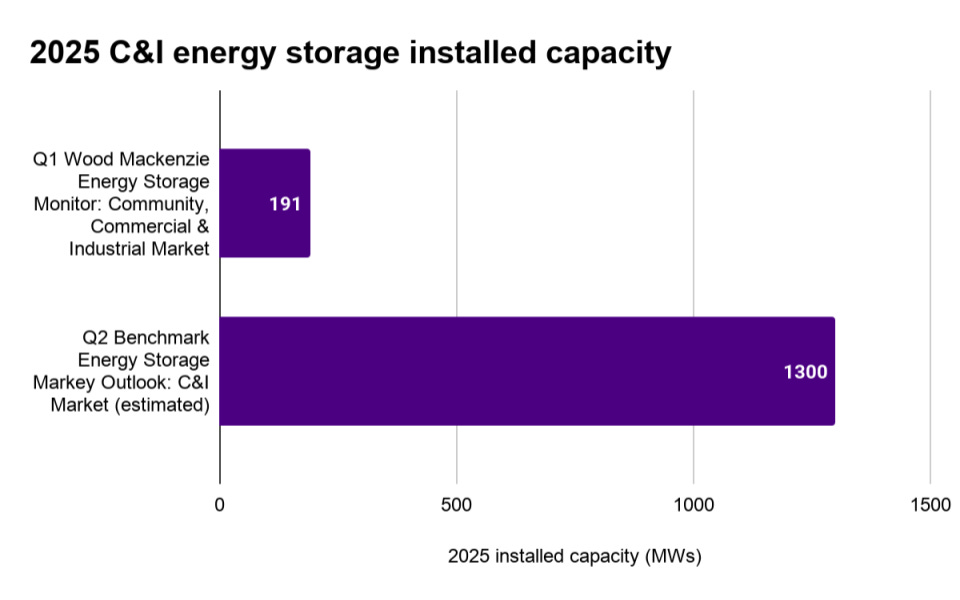
According to Wood Mackenzie and American Clean Power in the Q1 2026 Energy Storage Monitor, the community-scale, commercial and industrial (CCI) market for energy storage was 191 MWs in 2025. I should note that not all of this capacity is behind the meter because community storage in Massachusetts and Illinois can be in front of the meter. The team at Wood Mackenzie forecast a slight decrease in capacity in 2026 driven by Illinois community storage projects having delays to their commercial operation date. The primary markets today are California, Massachusetts and New York with Connecticut and New Mexico representing promising new markets. By 2030 they forecast 39% growth in the CCI energy storage market to 265 MW annually. In short they don’t forecast a meaningful growth over the next 5 years when compared to the size of the current residential market (deployed 2.7 GW in 2025) or utility-scale storage (16 GW in 2025).
By contrast, SEIA and Benchmark forecast in the Q2 2026 Energy Storage Market Outlook that there will be 3.97 GW/8.1GWh of C&I storage installed between 2024 and 2026 that are not associated with uninterruptible power supply (UPS) systems. Assuming a similar 2-hour average duration system, I estimate approximately 1.3 GWs of C&I capacity was installed behind the meter at C&I sites in 2025 based on the 2.617 GWh of C&I storage announced in 2025. According to the report, much of that is driven by the large storage projects announced at various data centers. One example of these kinds of projects is a 2 GW expected to come online from Energy Vault across multiple data center campuses.
These are wildly different numbers. My interpretation is that Benchmark counts data-center-adjacent BTM C&I storage that WoodMac’s CCI segment doesn’t. The Wood Mackenzie report represents the behind the meter storage capacity that is not associated with data centers or UPS systems. For small plug-in storage and Brightfield’s faster proposal software, I interpret them both going after the same under-served C&I opportunity Woodmac estimated at 191 MW in 2025. As Voltus pointed out in their press release, given the size of commercial energy consumption, this is a tiny fraction of the possible market. David Energy and Voltus are tackling this opportunity from two different angles.
Are small C&I batteries a big deal?
David Energy is on pace to installing 2,000 permissionless energy storage systems this year. In New York where they launched, I see a confluence of factors that make small commercial batteries appealing:
Installation friction: In New York there are key components for installation friction of a larger commercial battery. There is limited space for larger batteries that can potentially win on price per kwh, there is significant friction to get the certificates to get larger systems installed by licensed engineers, and interconnection queue delays.
Monetization: There is a pathway to monetize these smaller systems through demand charge management, retail-supply arbitrage and VPP revenue in ConEd.
Avoiding tenant/landlord conflicts: There are many commercial customers that do not own their buildings and cannot easily sign a long term energy storage lease agreement. Permissionless storage avoids the conflict between the incentives of the tenant and the incentives of the landlord. Every Electric is implementing a similar strategy for permissionless storage in New York apartments for a similar reason, though likely with a lower economic value proposition.
In the near term, I wonder how many other entities can take advantage of operational requirements and full stack integration for monetization of these assets in New York City or other markets. With 2,000 systems at 1.2-1.4 kw per system, this could be 2.4-2.8 MWs of capacity added for David Energy. David Energy already flagged they are seeing barriers to the supply chain just with their first 2,000 installs. Let’s say another 5 companies can get to David Energy’s scale by the end of 2027 like retailers in Texas or a VPP aggregator with small end customers like Enersponse. This would result in a total installed capacity of 10-15 MWs of permissionless commercial storage. The fundamentals of speed and avoiding conflicts between the tenant and landlord make me think this could be impactful for commercial storage by 2028 if other REPs or aggregators copy David Energy’s approach. In my most bullish scenario, supply chains are not constrained on these smaller batteries, the business model is replicable by many entities across major deregulated markets, and commercial customers that can’t install traditional storage clamor for this and installations 10X this could be close to 100 MWs of incremental capacity annually that Woodmac currently doesn’t forecast.
The monetization strategy and tenant/landlord conflicts could have much broader applications for David and other REPs that are vertically integrated across deregulated markets. Where there is lower installation friction than New York City, I question if a company like Base Power wouldn’t be able to offer higher value for resilience and savings at a lower cost with the same vertical integration. I see a limit for the total market size of small batteries when larger systems can easily be installed.
Does removing friction for storage proposals unlock Voltus’s battery business?
Looking at larger battery storage systems, Voltus made a bet acquiring Brightfield.ai. Looking across the press release and news outlets, they outlined three related components of their strategy:
Brightfield’s software unlocks automated initial proposals with access to interval data.
Voltus has existing relationships with over 13,000 sites as of 2024 with access to this data and tariff information.
Voltus’s BYOC contract in PJM provides fixed pricing to help the economics. Latitude Media described the last point this way: “BYOC provides a long-term fixed price signal for projects, while leveraging Brightfield’s tools are designed to bring down soft costs and accelerate timelines so that more of those projects can be built quickly.”
Brightfield was a 1-year old company with four industry veterans focused on a detailed problem they understood. I believe they could have developed a better initial proposal tool. The challenge for them before acquisition is they would need to access sites either one by one or through their channel partners. Voltus solves this problem with access to their full suite of customers’ existing interval and tariff data. This alignment I find compelling for starting conversations with existing customers.
I doubt 1-year of development even with Stem’s former CTO results in a defensible moat for this kind of software. I would expect companies like Stem, Energy Toolbase and other software companies to also fairly quickly be able to spin up a similar tool to automatically generate these kinds of reports for retailers and aggregators’ customers. This decrease in soft costs by saving 6-8 weeks on proposals paired with existing customer relationships could speed up new commercial storage projects.
Where I am skeptical is if Brightfield’s software will bring meaningful capacity to the BYOC contract in PJM. Others have written about the term mismatch between a 3-year fixed price of the BYOC contract versus the 15-20 year underwriting for a residential or commercial storage system. I would add that supply chain constraints especially for distribution switchgear that Wood Mackenzie estimates at over 10 months lead times could easily lead to an 18 month development cycle. While a battery could come online in 2028 for a conversation that starts in 2026, the 6-8 weeks of an initial contract are not the barrier to transformative speed of installation. I am also skeptical that Google’s BYOC pricing is so much better than market rates that it could underwrite the remaining 13-18 years of the battery.
Ultimately, because of the supply constraints that are not impacted by the proposal software, I’m skeptical that this software capability results in more than 100 MW annually of new installation in 2028 for Voltus. Still, unlocking merchant BTM C&I storage in PJM would be a meaningful incremental market driver compared to Woodmac’s base scenario. Looking at both of these bets together, I can see a world where both can result in a step change for the non-data center commercial storage market by adding an incremental 200 MW to a market already poised to get to over 200 MW annually. Simultaneously ~400 MWs annually is small compared to the annual growth of the US VPP market (4.5 GW annually) or residential storage market (2.7 GW annually).
WHAT DID I MISS — OR GET WRONG?
Spot a story that should have been in this week’s issue? Disagree with the way I’m interpreting the facts? Just comment in notes with a link to the story or your take.
Opinions are my own and not the views of my employer. Research and drafting for this issue was produced with the assistance of Claude AI. All editorial decisions are mine.