The fastest-scaling VPPs aren't batteries or thermostats
VPP Week-In-Review · Week of July 13, 2026 & Week of July 20, 2026 · Your weekly brief on virtual power plants in the US & Canada.

Three Takeaways
Residential VPPs added hundreds of megawatts in California the same week PJM’s demand response fleet shrank.
Voltus is positioning for an IPO, putting a public-market price on pure-play VPP operation for the first time.
The subscription home battery is spreading in New England: Haven’s $29-a-month Massachusetts launch, close behind Tesla’s discounted lease, turns VPP revenue into what makes residential storage cheap.
News Roundup
Grid Reliability · 🔴 Bearish
PJM’s 2028/2029 capacity auction clears at the cap, 6.8 GW short — with zero Order 2222 DER offers 📅 Published: 07/14/2026
PJM cleared 138,317.8 MW UCAP at the $325.00/MW-day price cap, 6,831.3 MW below its reliability requirement and 5.6 points under the 20% installed reserve margin. Demand response offered and cleared fell 277 MW to 7,017.4 MW UCAP, though every megawatt offered cleared in every LDA — the constraint is supply showing up, not clearing.
Regulatory & FERC · 🟡 Neutral
FERC Chairman Swett says PJM auction results “compound the alarm bells” 📅 Published: 07/17/2026
Swett responded to the auction at FERC’s monthly open meeting, pointing to the shortfall and the roughly 525 MW of new and uprated generation that cleared. Her framing names the failure to stimulate demand response as a core diagnosis, not a footnote. That lands while FERC’s PJM governance review and the large-load show-cause proceeding are both live, which puts DR market design squarely inside a rulemaking already in motion.
Grid Reliability · 🟢 Bullish
PJM calls load management for the second time in two weeks, requests DOE emergency order through July 21 📅 Published: 07/14/2026
PJM issued a Maximum Generation Alert and a Load Management Alert for July 15, putting Pre-Emergency and Emergency Demand Response on notice again barely a week after the July 2–3 dispatches. It also asked the DOE for a combined emergency order covering July 15 through July 21. The operational record keeps validating the DR fleet in the same season the forward market failed to attract more of it.
Grid Reliability · 🟢 Bullish
PJM grid hit by voltage disturbance after data-center load abruptly drops offline 📅 Published: 07/24/2026
On July 22, more than 3 GW of northern Virginia data-center load dropped offline at once after a transmission line tripped, about 3% of PJM demand at that moment. The sites switched to backup power, and the voltage and frequency swing carried from Washington to Chicago. Stabilizing it took ten minutes, not the usual seconds. Volatility of that size is the clearest operational argument yet for dispatchable behind-the-meter resources that can hold voltage and frequency when a large load walks off without warning.
Grid Reliability · 🟡 Neutral
Data centers drove $6.3B in PJM capacity auction costs: market monitor 📅 Published: 07/20/2026
Data centers drove $6.3 billion of the $16.4 billion in charges from PJM’s latest capacity auction, or 38%. Across the last four base auctions they account for $29.4 billion of $63.6 billion, 46%, said Joseph Bowring, PJM’s independent market monitor. His fix is to move large loads into separate 15-year backstop auctions, so their demand uncertainty stops loading capacity costs onto everyone else. Paying for capacity against load that may never arrive is the sharpest case going for demand-side flexibility over new supply.
Regulatory & FERC · 🟡 Neutral
FERC fails to shield PJM consumers from data-center transmission costs: ratepayer advocates 📅 Published: 07/21/2026
Ratepayer advocates from Delaware, Illinois, Maryland, Ohio, and Pennsylvania asked FERC on July 17 to rehear its June large-load “show cause” order for PJM. Their complaint is that the order lets existing customers pick up the network-upgrade costs data centers cause. They want large loads required to pay the full cost of the upgrades they trigger. Until FERC settles who pays for interconnection, curtailable and behind-the-meter alternatives get priced against an unsettled baseline.
Utility Programs · 🟢 Bullish
Sunrun’s California distributed power plant expands to 425 MW of dispatchable capacity 📅 Published: 07/14/2026
Sunrun now has more than 80,000 California households enrolled, representing over 110,000 home batteries — a fivefold increase from the 16,000 customers at its 2024 launch. This is the first season it dispatches through both the CEC’s Demand Side Grid Support program and the CPUC’s Emergency Load Reduction Program, the latter under bilateral contracts with PG&E and SCE. As a single front-of-meter asset it would rank in California’s top 10 batteries, assembled without land, transmission, or an interconnection queue.
Utility Programs · 🟢 Bullish
FranklinWH selected for two Texas VPP programs at Austin Energy and Entergy Texas 📅 Published: 07/16/2026 (announced 07/14/2026)
Austin Energy’s Power Partner Battery Pilot pays a $500 upfront incentive plus roughly $300 a year, structured as $75/kW of average output delivered during events and capped at 1,500 systems. Entergy Texas pays enrolled customers up to $325 annually for automated dispatch. The Austin pilot ladders into a 78 MW demand response target by 2027 and 270 MW by 2035, and it follows FranklinWH’s entries into SRP and APS programs in Arizona earlier this year.
Research & Reports · 🟡 Neutral
Foley Hoag: Puerto Rico’s CBES program hit 48 MW in a single dispatch from ~70,000 batteries 📅 Published: 07/13/2026
Peter Ross pulls together the state of the VPP market for legal and developer audiences, and the Puerto Rico section is the part worth reading. LUMA’s CBES program went from 5,726 enrolled customers and 53 grid events in its first nine months to 11,157 by May 2025, then dispatched roughly 70,000 batteries for 48 MW during a summer 2025 emergency — covering an approximately 50 MW generation shortfall at $1.25/kWh discharged. The transferable lesson he draws is that simplified enrollment and opt-out rights on individual events, not incentive size, are what produced the enrollment curve.
Project Finance · 🟢 Bullish
Voltus raising $50M–$100M in what it intends as its last private round 📅 Published: 07/17/2026
Three sources told Axios Pro the raise is sized between $50 million and $100 million, with the company treating it as its final round before going public. It arrives weeks after the Google bring-your-own-capacity agreement in PJM. A pure-play VPP operator testing public markets would give the whole category its first real comparable.
Research & Reports · 🟡 Neutral
US data-center electricity use could more than double by 2030: report 📅 Published: 07/21/2026
A Kansas Health Institute report, using Lawrence Berkeley National Laboratory data, puts US data-center demand at 183 TWh in 2024, more than 4% of national use. It projects that rising 133% to 426 TWh by 2030. Today that load runs 56% on fossil fuels, 22% renewables, 21% nuclear. Load growth of that size widens the market for anything that can shift or shed demand in the hours the grid runs tightest.
Grid Reliability · 🟡 Neutral
ERCOT hits record demand above 91 GW during Texas heat wave 📅 Published: 07/22/2026
ERCOT demand cleared 91 GW for the first time on July 22, hitting about 91,300 MW. It was the second record in a week, after Tuesday’s 87,000 MW broke a mark that had held since August 2023. The grid stayed in normal operations with no conservation call, and wind and solar carried about 37% of supply. A record set without an emergency is a rough measure of how much room dispatchable flexibility has to work before the call that does come.
Product Announcements · 🟢 Bullish
Startup offers low-cost home batteries to Massachusetts residents 📅 Published: 07/21/2026
Haven Energy began offering an installed 15 kWh home battery across four southeastern Massachusetts counties for $29 a month on a 10-year contract, against roughly $15,000 to buy a system outright. Haven keeps ownership and enrolls the batteries in ConnectedSolutions, the state demand-response program, where a typical battery earns about $1,375 a year and the new ConnectedSolutions+ tier pays more in grid-congested areas. That program revenue funds the low monthly price. The move follows Tesla’s discounted New England lease last month, and points to VPP earnings, not upfront rebates, as the mechanism making residential storage affordable.
M&A · 🟢 Bullish
Carrier accelerates intelligent-building strategy with acquisition of 75F 📅 Published: 07/23/2026
Carrier bought 75F, a cloud-native, wireless, AI-enabled building-automation firm. It plans to fold 75F’s generative and agentic AI and auto-commissioning into Carrier’s WebCTRL controls base and QuantumLeap data-center thermal suite. The deal pushes Carrier further into autonomous control of commercial HVAC load. Owning the intelligence layer on C&I buildings is how equipment makers position to capture the grid-interactive, flexible load that VPPs have long struggled to aggregate.
📊 By the Numbers
6,831.3 MW: UCAP shortfall against PJM’s reliability requirement for 2028/2029, up from 6,516 MW the prior auction.
7,017.4 MW: demand response UCAP cleared, down 277 MW year over year. All of it cleared, in every LDA.
$325.00/MW-day: the price cap, which every LDA cleared at. PJM’s own no-cap simulation puts the clearing price at $554.72, and COMED at $776.69.
425 MW: peak dispatchable capacity in Sunrun’s California distributed power plant, from 110,000+ home batteries across 80,000 households.
$75/kW: Austin Energy’s payment for average output delivered during demand response events in its Power Partner Battery Pilot.
48 MW: capacity LUMA dispatched from roughly 70,000 Puerto Rico batteries in a single summer 2025 event, against an approximately 50 MW shortfall.
$1.25/kWh: what LUMA pays CBES participants for energy discharged during grid events.
3 GW: PJM data-center load that dropped offline on July 22, about 3% of demand at the time.
10 minutes: how long PJM took to restabilize, against the usual few seconds.
$6.3 billion: the data-center share, 38%, of PJM’s latest capacity-auction charges.
91,300 MW: ERCOT’s new demand record on July 22, set with no conservation call.
426 TWh: projected US data-center use by 2030, up 133% from 183 TWh in 2024.
$29 a month: Haven Energy’s price for an installed 15 kWh home battery in Massachusetts, on a 10-year contract.
🗓️ On the Radar
August 17, 2026 — deadline for RTOs/ISOs and transmission owners to file compliance responses to FERC’s Section 206 large-load tariff order.
September 2026 — PJM’s targeted date for the data center reliability backstop capacity auction, capped at $555/MW-day.
December 9, 2026 — PJM’s capacity auction for the 2029/30 delivery year, which the backstop procurement is meant to precede.
💬 My Take
In PJM there is a need for incremental capacity to come online fast. And in the same week Sunrun in California showed a pathway to add 100s of MW of nameplate capacity in under 2 years. Over the last three years, VPPs ability to scale quickly has become conventional wisdom within the industry. The report by Foley Hoag exemplifies what I’ve seen as conventional wisdom: “Because VPPs aggregate existing behind-the-meter resources, they avoid the multi-year permitting, siting, and interconnection timelines that plague utility-scale projects.”
This is true. And this analysis misses the reality of how only some VPPs have been able to reach the scale and speed to offset utility-scale projects. I wanted to find the prior successes. I looked at all the examples I could find since 2016 of VPPs that publicly scaled, quickly and could be considered accredited capacity.
I assumed residential assets would grow faster than commercial and industrial programs. My assumption was in line with the potential from Tesla, Sunrun and Renew Home with 16.8 GW of nameplate capacity and Sunrun’s CalReady announcement. There were 433 VPP programs monetized in North America in 2025 according to Wood Mackenzie. I focused on 14 I assumed would meet this standard. I was wrong on seven of them. Here is what I saw:
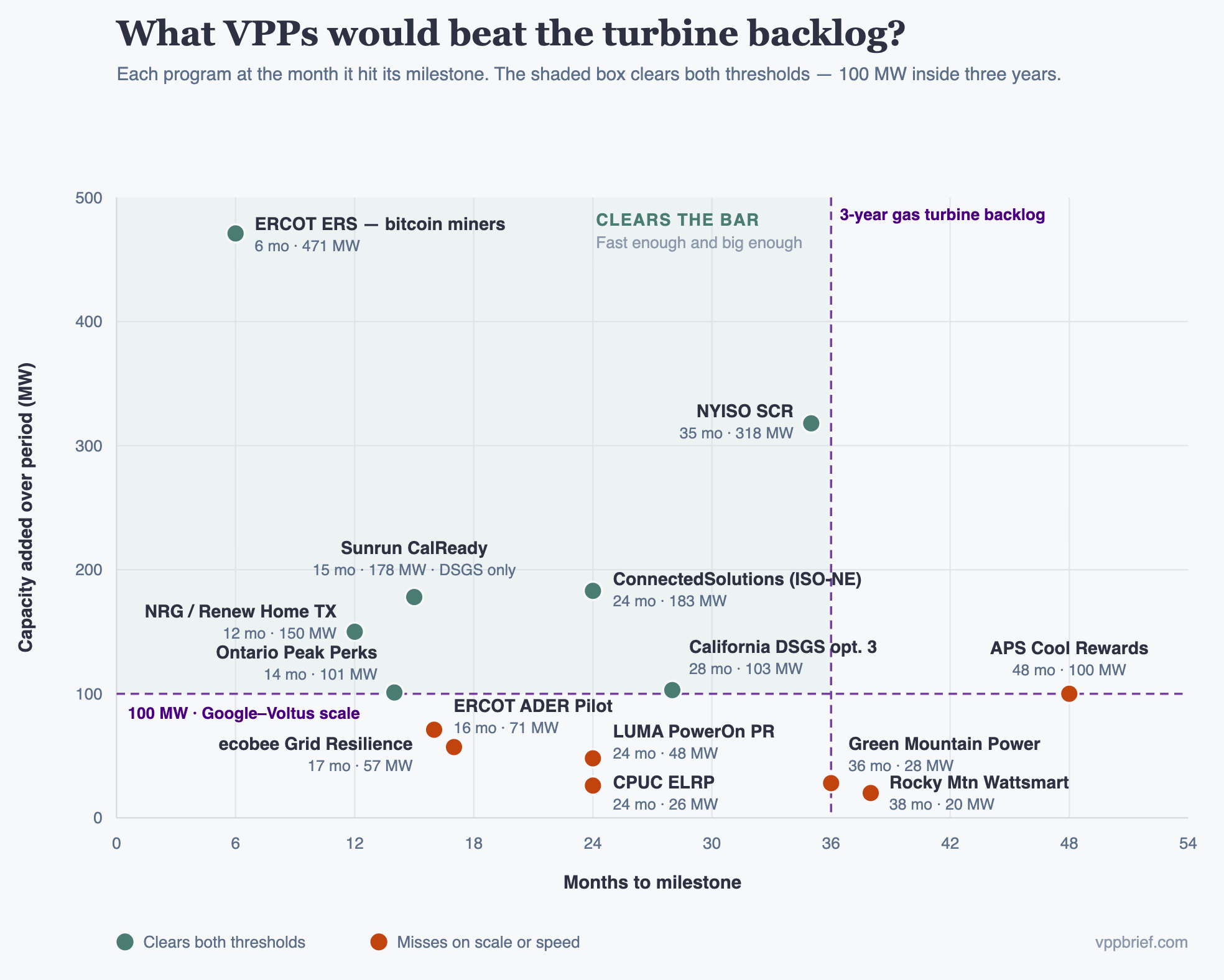
My reflections on the themes I see in this graph:
The scale of bitcoin mining in Texas was my biggest surprise. In the summer season of 2025 (June-September), crypto miners were 56% of ERS capacity or 1,240 MW. By the winter of 2025 (December-March), crypto miners represented 64% of ERS capacity or 1,711 MW. This means that 471 MW were added in six months. I could not find another example of VPP growth in the US that comes close for speed or scale. Importantly, this was partially caused by miners realizing they could get ERS revenues without significant incremental dispatches beyond their existing responses to 4CP. That may also result in those same miners being required to exit ERS. With crypto miners like Riot and TeraWulf transitioning into neoclouds that are supporting inference there are no technical limitations to them being able to take the same capabilities for curtailment and applying them to new load types. OpenAI, Anthropic, Google, and AWS all have a batch or flex service tier that allows some time shifting for inference jobs. Google has already been using this to enable 1 GW of load flexibility. I expect other hyperscalers to follow and colocation leases to incorporate data center flexibility to speed up interconnection.
Residential batteries’ accredited capacity can be a small fraction of nameplate capacity. Nameplate capacity is the size of an asset measured in MW or KW: not all of this will be curtailed. For example California’s Demand Side Grid Support has released performance results for their 2024 season. The program had 220 MW of nameplate capacity in Option 3 for batteries, but just over 100 MW of delivered capacity. In 2025 Sunrun’s portfolio in DSGS option 3 would only have accredit capacity of accredited capacity of 178 MW against the 425 MW of nameplate capacity (see methodology for additional details). Green Mountain Power similarly has 53 MW of nameplate capacity, but has forecast accredited capacity of 28 MW. Puerto Rico’s CBES VPP is more extreme because only a fraction of the battery’s energy (KWh) is opted in by default. While the program has half a GW of nameplate capacity, the VPP has curtailed 48 MW. The difference between nameplate capacity and proxies for accredited capacity is the reality residential storage operators need to incorporate into their VPP offerings and pitches to data center developers.
Traditional commercial and industrial DR can reach this scale with the right incentives. ConnectedSolutions’ early growth (2018-2021) was driven by commercial and industrial customers’ curtailment. NYISO SCR similarly was able to achieve significant growth. This highlights how with the right incentives and enrollment process, commercial customers can bring meaningful scale. This is important especially in PJM where over 2 GW of capacity has left the market since 2018. With higher prices, a multi-gigawatt capacity shortfall and higher effective load carrying capacity (ELCC), I’d expect some of those customers can be brought back to participate.
Residential thermostat programs can scale quickly. Renew Home’s partnership with NRG and Ontario’s Peak Perks program both meet this criteria. ecobee’s Grid Resilience portfolio in ERCOT could still meet the criteria with another 2 years to achieve the minimum scale threshold. The installed base is ubiquitous, growing and OEMs have over a decade of experience with VPPs. This is not guaranteed. Enrollment barriers or limitations to a small number of OEMs can prevent hitting the necessary scale.
Stepping back, my take away is that VPPs across asset classes and in diverse geographies have grown to the scale of 100 MW of accredited capacity in under 3 years. I see evidence in these examples that VPPs are able to do this in PJM over the coming years.
Below is more context on each metric and my selection process:
Speed: When I say quickly, I mean a three year window because this is the estimated backlog for getting gas turbines from GE Vernova or the other gas OEMs. Under three years effectively is a meaningful improvement over incremental generation that would need to come online due to the backlog of generators, interconnection, siting and permitting timelines. When looking at programs with longer operating history, like ConnectedSolutions in New England, I looked for public information of any 3 year time period since 2016 that would meet this criteria. This is measured in months until an announced scale milestone.
Scale: For scale, the minimum threshold I’m setting is 100 MW of capacity because this aligns with the contract size Google signed with Voltus for a Bring-your-own-capacity VPP and a minimum scale that has been shown to be meaningful to a hyperscaler. In many programs, aggregators or utilities have an estimate of what a portfolio will realistically be able to curtail called a nomination. This can diverge meaningfully from what is actually curtailed unless there are strong incentives for aggregators to set nominations very close to true performance. For example, California’s Emergency Load Reduction Program (ELRP) is generally considered a large program, but in their most recent 2023 full portfolio dispatches I could only find 26 MW of curtailed capacity.
Capacity Accreditation: I also only looked at VPPs that are in a single program with a good proxy for accredited capacity. I identified three proxies: actual curtailed capacity in program assessments, an existing accredited capacity mechanism (for example PJM’s Emergency Load Response Program) or nominations that are required to be closely aligned with actual curtailment. Programs that have this kind of incentive include Emergency Response Service (ERS) in ERCOT, Special Case Resources in New York among other programs.
I included only Sunrun’s CalReady VPP that I could reasonably estimate was in DSGS because that portion of the VPP meets all the thresholds. Brattle was commissioned by Sunrun and Tesla to publish a full report on performance results from the test event they ran last year. I find the methodology sound to use as a good proxy for capacity accreditation including showing that Sunrun had 361 MW and there were only 64 MW in ELRP across all participants. A conservative assumption is that all 64 MW of ELRP assets were in Sunrun’s portfolio. To convert those to accredited capacity estimates, Brattle suggests an ELCC of 60%. That results in 178 MW proxy for accredited capacity for Sunrun’s performance in 2025 ((361 MW-64 MW)*.6). You’ll notice in the chart, this is larger than the entire DSGS Option 3 portfolio. That is because I could only find public performance data for DSGS from the 2024 season while Sunrun’s data is from 2025.
Selection: I looked at RMI, VP3’s and the LBNL’s public research for examples as well as my personal experience working with VPPs at Leap. I didn’t include announced projects that would meet these requirements like BasePower’s 100 MW contract with CoServe or Voltus and Google’s deal.
What Did I Miss — or Get Wrong?
Spot a story that should have been in this week’s issue? Disagree with the way I’m interpreting the facts? Just comment in notes with a link to the story or your take.
Opinions are my own and not the views of my employer. Research and drafting for this issue was produced with the assistance of Claude AI. All editorial decisions are mine.