PJM will curtail large loads before it calls VPPs
VPP Week-In-Review · Week of July 27, 2026 · Your weekly brief on virtual power plants in the US & Canada.

Three Takeaways
PJM will curtail unsupplied large loads before it deploys paid demand response, putting a new demand-side tranche ahead of the DR fleet and paid at the compensation rate of demand response.
Tesla is now publishing live VPP operations across five regions, with a headline figure of more than 2 GW that measures nameplate Powerwall capacity rather than accredited capacity.
The single largest structural barrier to residential VPP participation in PJM was ruled unlawful this week, though FERC has yet to say what replaces it.
News Roundup
Regulatory & FERC · 🟡 Neutral
PJM Board Directs Action on Resource Adequacy, Affordability and Large Loads 📅 Published: 07/27/2026
New large loads that have not brought their own capacity by June 1, 2027 will be curtailed before PJM deploys Pre-Emergency Load Management, at a compensation rate of VPPs. PJM’s own framing notes that Load Management resources are paid to reduce consumption, which is the contrast the new curtailment order creates: a demand-side tranche that dispatches first and gets quantified later. The companion Reliability Backstop Procurement, a one-time auction backfilling the 2028/2029 shortfall, runs September 30 through October 21, with the total cost of accepted offers capped at $555/MW-day. New demand response and DERs qualify only where aggregators show sites and contracts for all 15 years.
Regulatory & FERC · 🟢 Bullish
FERC recognizes that “data blocking” distorts wholesale markets 📅 Published: 07/30/2026
FERC granted a Voltus/Mission:data complaint on July 29, finding PJM’s tariff unjust, unreasonable and unduly discriminatory because it requires curtailment service providers to submit smart meter data that utilities will not release. The order found “specific, demonstrable evidence” that CSPs “cannot reasonably access residential customers’ interval meter data with the efficiency and scale needed to effectively participate in the ELRP.” Some 86% of PJM customers have a smart meter, against more than $8.9 billion spent on metering in the region. Commissioner LaCerte dissented, arguing the inaccessibility is a product of state policy rather than utility conduct. The remedy is still open, but this is the barrier that held Voltus to 4% enrollment across 20,000 ComEd thermostat customers, now formally ruled unlawful.
Regulatory & FERC · 🟡 Neutral
IESO Applying Data Center Standards Ahead of Market Rule Changes 📅 Published: 07/28/2026
Ontario’s system operator is imposing new reliability requirements on large computational loads through connection assessments, months before it expects to write them into its market rules and manuals. The draft standards include voltage ride-through rules setting when a large load must stay connected during a disturbance and when UPS-supported demand may transfer off the grid. Data centres are forecast to reach 13% of new Ontario demand by 2035, so IESO is fixing the reliability obligations of that load before the market rules that would price flexibility from it.
Product Announcements · 🟢 Bullish
Tesla launches live VPP dashboards across five regions 📅 Published: 07/31/2026
Tesla opened public dashboards showing live operations for its Powerwall virtual power plants in California, Puerto Rico, Texas, New England and Australia, each reporting homes enrolled and total capacity alongside network-wide totals. Tesla Energy put the combined fleet at more than 2 GW, dispatched through its Opticaster platform, which aggregates encrypted Powerwall data every few seconds into a single coordinated command. That 2 GW is nameplate capacity across enrolled homes, the figure a residential fleet starts from rather than the accredited capacity a grid operator counts against a reliability requirement.
Utility Programs · 🟢 Bullish
Vermont’s largest energy source is now a virtual power plant 📅 Published: 07/28/2026
Green Mountain Power (GMP) dispatched 90 MW from its VPP and other assets during Vermont’s early July heat wave, which the utility estimates cut $6 million from peak costs for all customers, against $11 million saved across 2025. The portfolio now totals 110 MW, the largest single power resource in the state by capacity, with 53 MW of that from residential batteries across 5,000 customers and more than 10,000 units. GMP has already retired peakers in Vergennes and Rutland through the ISO-NE retirement process. GMP said as the VPP grows they plan to take more peaker plants offline.
Utility Programs · 🟢 Bullish
Battery virtual power plant that paid homeowners $5.4 million now expanding to EV batteries 📅 Published: 07/27/2026
Massachusetts is extending ConnectedSolutions to residential vehicle-to-grid, with The Mobility House, EnergyHub and Sunrun participating and EnergyHub’s Edge DERMS handling dispatch. Vehicles eligible at launch include the Ford F-150 Lightning, Nissan Leaf, Kia EV9, Polestar 3 and Volvo EX90, paid on the same basis as home batteries at $275 per average kW of summer event contribution. Program batteries delivered roughly 40 MW of net summer capacity in 2025 against a 125 MW target for 2025 to 2027, so the gap is being closed by adding an asset class rather than by deepening the one already enrolled.
Regulatory & FERC · 🟢 Bullish
NJ Proposes “Virtual Power Plant” Plan to Save Ratepayers Millions Annually 📅 Published: 07/27/2026
The New Jersey Board of Public Utilities held a July 30 kickoff on its VPP Straw Proposal, issued under Governor Sherrill’s January energy-emergency executive order, with written comments due August 17 in Docket No. QO26030099. RTO Insider reports a $68 million phase one targeting a 3% peak demand cut by mid-2027 across PSE&G, JCP&L, Atlantic City Electric and Rockland Electric customers. Board President Ben Hertz-Shargel worked at Energyhub and ran grid edge research at Wood Mackenzie before taking the seat.
📊 By the Numbers
70 GW: forecast growth in PJM large load by 2038, against roughly 15 GW of generation retired since 2022.
15 years: commitment length DR and DER aggregators must back with sites and contracts to bid into the backstop procurement.
50 MW: site threshold defining a Large Load for PJM’s new registry.
2 GW: nameplate Powerwall capacity Tesla now reports across its five live VPP dashboards.
5 regions: California, Puerto Rico, Texas, New England and Australia, where Tesla publishes live VPP operations.
110 MW: Green Mountain Power’s total VPP capacity, now Vermont’s largest single power resource.
$6 million: savings GMP estimates its 90 MW July dispatch delivered to all customers.
$5.4 million: paid to 5,251 Massachusetts residential battery participants in the 2025 ConnectedSolutions season.
$275: per average kW of summer event contribution, the ConnectedSolutions residential rate now extended to V2G.
$68 million: phase one budget for New Jersey’s proposed statewide VPP.
3%: peak demand reduction New Jersey is targeting by mid-2027.
13%: share of new Ontario electricity demand forecast to come from data centres by 2035.
🗓️ On the Radar
August 17, 2026: deadline for written comments on New Jersey’s VPP Straw Proposal, Docket No. QO26030099.
September 30 to October 21, 2026: window for PJM’s one-time Reliability Backstop Procurement.
Early December 2026: PJM releases backstop procurement results, ahead of the 2029/2030 capacity auction.
June 1, 2027: date after which new large loads without their own supply face curtailment before Pre-Emergency Load Management.
💬 My Take
PJM’s Board of Managers directed PJM to file two proposals with FERC. What has gotten the most coverage is all the work on the Reliability Backstop Procurement: the carrot. I’m interested in the stick: the Interim Resource Adequacy Service (IRAS) proposal is that any new large load that does not have new capacity or allocated Unforced Capacity (UCAP) by June 1, 2027 will be curtailed before demand response. I think this impacts VPPs in PJM in two ways:
This is the incentive for data centers to procure capacity including VPPs: they have a high value of lost load and will be curtailed prior to demand response.
This creates a new service that is dispatched prior to pre-emergency conditions and not easily accredited prior to the dispatch.
PJM is not the first to propose data centers be curtailed. I walked through SPP’s and TX’s approach as an opt-in for faster interconnect in May. Alberta has proposed a Bring-Your-Own-Generation framework that would allow data centers to have a faster interconnect process if they are able to be curtailed and supported by gas generation they build. What makes PJM’s proposal unique is that the data centers aren’t opting in; they would be able to be curtailed after June 2027 if they are greater than 50 MW and don’t have new capacity or allocated UCAP. And data center curtailment now comes before pre-emergency dispatch for VPPs.
For data center developers and operators, their exit from this program is clear: bring your own new capacity (BYONC - I’m pronouncing it bounce) whether in the form of generation, onsite curtailment or VPPs. This makes sense for these entities because they have a high value of lost load. I’m optimistic about this pushing more data center developers to explore VPPs among their new capacity options. This puts a premium on annual capacity that has not been registered in PJM’s DR Hub in the 2026/27 or 2027/28 delivery years. This could help bring some of the more than 2 GW of DR capacity that was participating in 2018/19 compared to 2026/27.
At first glance this helps avoid possible blackouts and allocate costs for new capacity to the data centers and not other ratepayers. The real challenge I see is that data center nameplate capacity and details on ramp rates are not sufficient to determine how much load can be curtailed during a grid emergency.
In the proposal, PJM creates a registry of large loads that requires static information about the data center load including load quantity, ramp schedule, backup generation capacity and fuel type and UCAP allocation. PJM assigns a zone MW obligation based on this registry with a 10-minute dispatch requirement, but no way to verify before the event the amount of expected curtailment that will occur. For this they would need utilization factor, coincident peak behavior, or expected availability.
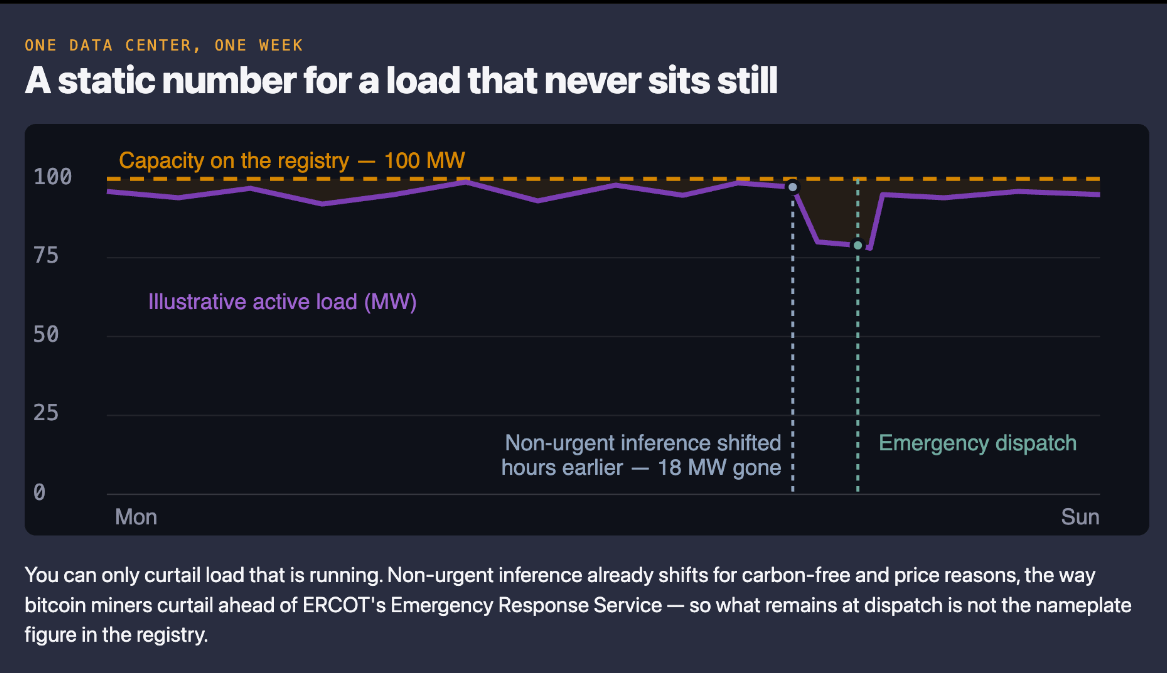
Data center demand especially with AI use cases are not static or have consistent utilization. In May, NERC issued a level 3 reliability alert precisely because data center demand spikes and drops pose concerns to grid operators. While grid operators are getting more insight on real time telemetry for voltage stabilization, this data is not being applied to forecast curtailable capacity during a grid emergency in this proposal. Data center loads are also going to change drastically over the coming years both in scale and type of compute jobs. JLL forecasts forecast inference will overtake training loads by 2027.
I also noted last week that we are going to see more time shifting of non-urgent inference loads with the business models already in place from OpenAI, Anthropic, Google, and AWS. The time shifting available in some inference jobs and other incentives could result in shifting prior to an IRAS dispatch. We see examples of this kind of curtailment prior to emergency conditions in how bitcoin miners have dispatched prior to ERCOT’s Emergency Response Service in response to coincident peak management. In aggregate, this means how much each data center will have to curtail with backup generation and load shifting will likely not be equivalent to the nameplate capacity information tracked in the registry.
The analogies to batteries in PJM are stark. Battery nameplate capacity first is derated to what can be expected to curtail, sometimes by over 50% in VPPs across the US. That nominated capacity then gets a further haircut based on the effective load carrying capacity. This is forecast to range from 15-48% derate depending on the duration and if storage is registered as storage or demand response. Then if they underperform, there can be significant penalties applied. Large loads go through none of that. And if data centers’ curtailment doesn’t show up in line with PJM’s expectation, VPPs will have to step in.
What Did I Miss, or Get Wrong?
Spot a story that should have been in this week’s issue? Disagree with the way I’m interpreting the facts? Just comment in notes with a link to the story or your take.
Opinions are my own and not the views of my employer. Research and drafting for this issue was produced with the assistance of Claude AI. All editorial decisions are mine.